





Case study
They needed four cyclones to be identical. The drawings left the angle blank.
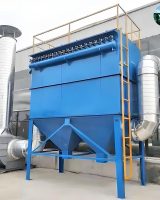
An Italian processor ordered four cyclone separators for a powder and bulk material line — and all four had to be identical. The drawings left the inlet angle and rotation direction open, so we asked before production started. Add a noise-reduction build, video updates every three days, and a new enquiry the same week the equipment was ready.
- Country
- Italy
- Industry
- Industrial powder and bulk material processing
- Equipment
- Four custom cyclone separators fabricated to one confirmed geometry (45° inlet/outlet angle); noise-reduction layer and acoustic enclosure; centrifugal fan
- Lead time
- Approximately eight months from first contact to completed production (December 2025 – August 2026); follow-on enquiry the same month
The enquiry came from an Italian industrial processor working with powder and bulk materials. The specification was for four cyclone separators, and it carried two demands that shaped the whole project: all four units had to be identical, and they would need a noise-reduction layer with an acoustic enclosure to suit the plant they were going into. The drawings were detailed — but they left two things open: the inlet and outlet angle, and the direction each cyclone should rotate.
Why it worked
- We asked before we cut steel. With the inlet/outlet angle and the rotation direction missing from the drawing, releasing four units into production would have risked four units assembled the wrong way. Rather than assuming a value, we put the question back to the customer — and produced a sketch so their engineers could check the geometry instead of trusting a number. They confirmed 45°, and the answer came back in the simplest possible form: made all 4 cyclones with 45°.
- We stayed with a conversation that had gone quiet twice. Between the first enquiry and the purchase order, the thread stalled for extended periods — twice. Rather than waiting for it to restart on its own, we reached out directly, as the supplier already familiar with their requirements, and rebuilt the dialogue from there. In a long-cycle industrial sale, persistence is part of the service, not a sales tactic.
- “Identical” was handled as a technical specification, not a preference. Four units sharing one fabrication run multiply any unverified variable by four. Locking a single confirmed angle before production is what made “all four the same” a manufacturable instruction rather than an aspiration.
- Progress was reported on a fixed rhythm — on video. When the customer asked for regular updates, we committed to one every three days rather than “as needed”, and sent workshop video so progress could be seen rather than read. Mid-build, the customer asked why the support bracket from the earlier drawing was not visible. Nothing was missing: the cyclones had simply not been assembled yet, and the main frame sits below them. Explaining the assembly sequence openly settled the question before it became a dispute.
- Noise was engineered in, not retrofitted. The noise-reduction layer and the acoustic enclosure were part of the build and were completed before the units went for painting — not bolted on afterwards as an afterthought.
- They came back the same week. While the equipment was being made ready for assembly, the customer sent a new specification: a dust extraction table for their powder-mixing station. We replied the following day, confirmed it could be built to their dimensions, and raised a technical point of our own — the cone would need to be deepened to house the fan internally. They came back asking how much deeper, and the next round of design discussion began.
Scope of supply
| Cyclone separators | Four units, fabricated to one confirmed geometry — 45° inlet/outlet angle verified by sketch before production |
| Noise control | Noise-reduction layer and acoustic enclosure, fitted as part of the build |
| Air movement | Centrifugal fan (37 kW) in the quoted configuration |
| Progress reporting | Video updates every three days through the production cycle |
| Follow-on scope | Dust extraction table for the powder-mixing station — customer-specified, custom-built to their dimensions |
What we learned
Custom work is not a matter of accepting a specification and quoting it back. It is about finding the two things a drawing leaves blank — and asking about them before anything is cut. On this project that was a single angle, repeated across four units. It is also about the parts of a sale that have nothing to do with the machine: keeping a stalled conversation alive, reporting progress on a rhythm the customer can rely on, and answering questions about the build sequence with the drawing open rather than with a defence. The four cyclones were ready for assembly — and the next enquiry was already on the table.